Crafting Memories: Ryder LeVieux's journey through her first solo exhibition Aggregate at Paris College of Art

A lot of artists like to use found objects, but I actually feel uncomfortable using them because the history those objects have gone through is so important. – Ryder LeVieux
Featuring Ryder LeVieux’s first solo exhibition, the artist reflects on her artistic journey shaped by her experiences and connections. With a focus on memory, emotion, and materiality, Ryder’s work on Aggregate, serves as a testament to her growth as an artist and her exploration of personal history through architecture and reproduction of found objects.
In an interesting discussion, she shares how her time at PCA not only solidified her identity as an artist but also encouraged her to embrace imperfection and innovation in her creative process.
Can you tell us more about your background and your time at PCA?
Sure! I grew up in California and decided to move to Paris in 2020, during the pandemic. Because having a student visa was the only way I could enter the country, my parents couldn’t come with me, so I was like, “I’m going to try this.” I did the Foundation year and then decided to study Fine Arts, which is why I came to an art school in Europe in the first place. I did that for four years and graduated last year, in 2023. Now I’m doing a certificate in communication design at Paris College of Art (PCA) as well.
How did your time at school shape your artistic voice and influence the development of “Aggregate”?
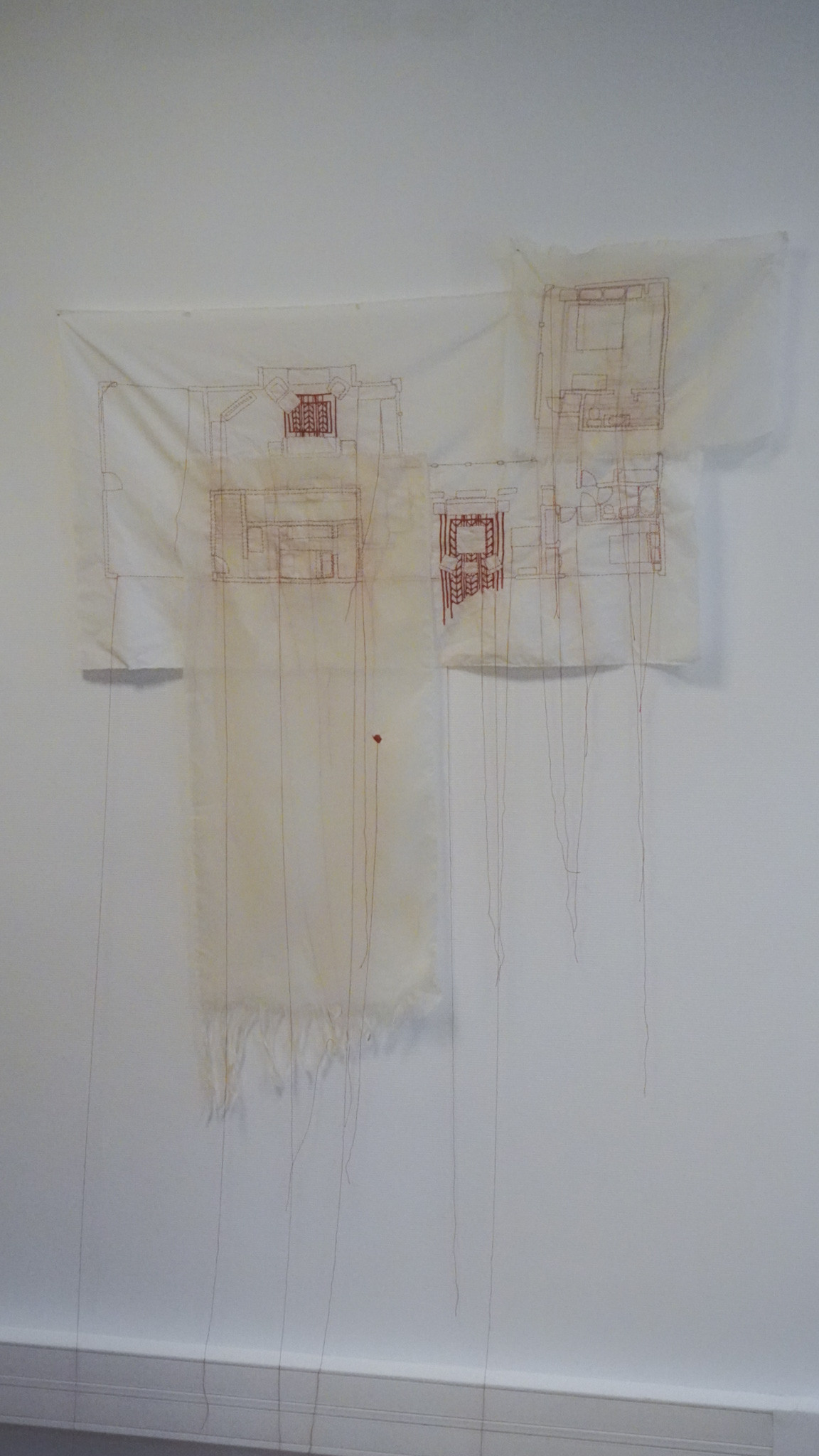
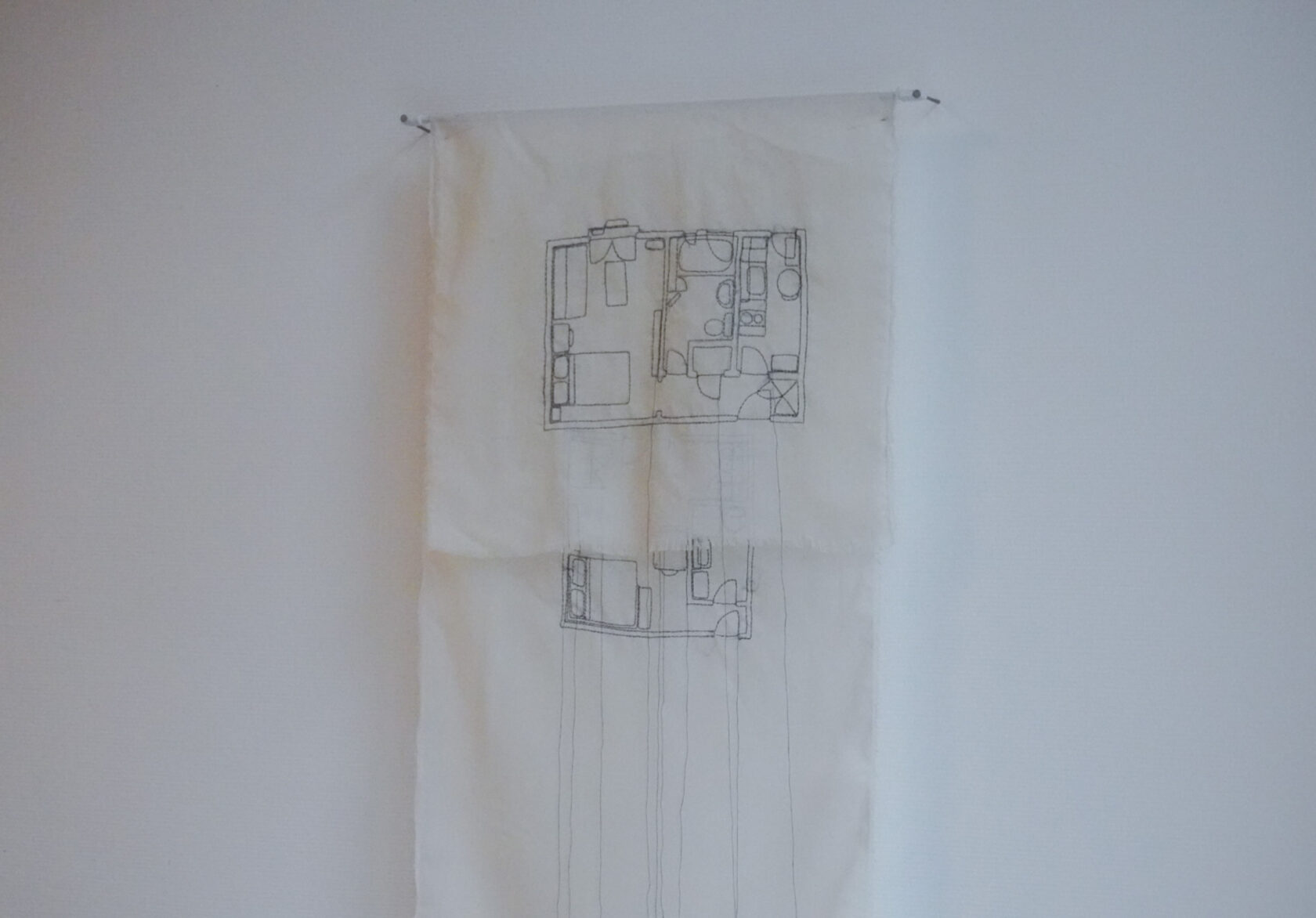
Oh gosh, I mean… I think it developed everything. But the main thing is: before I came here, I wasn’t really focused on memory as much. My time at school, being away from home, increased that focus. So my work before wasn’t centered on memory at all. After coming here, the idea of home really evolved, especially having to move here completely alone and having to create my own home from nothing. Both my parents are architects, and that also plays a huge role in the entire concept of architecture behind my work. It brings back memories, not just in terms of how home and architecture can evoke memories for everyone, but specifically for me, because floor plans were the first things I learned how to draw. Like, drawing after ballet in my mom’s office with her architecture materials, and coloring in a floor plan.
What specific experiences or projects at PCA helped refine your current artistic practice?
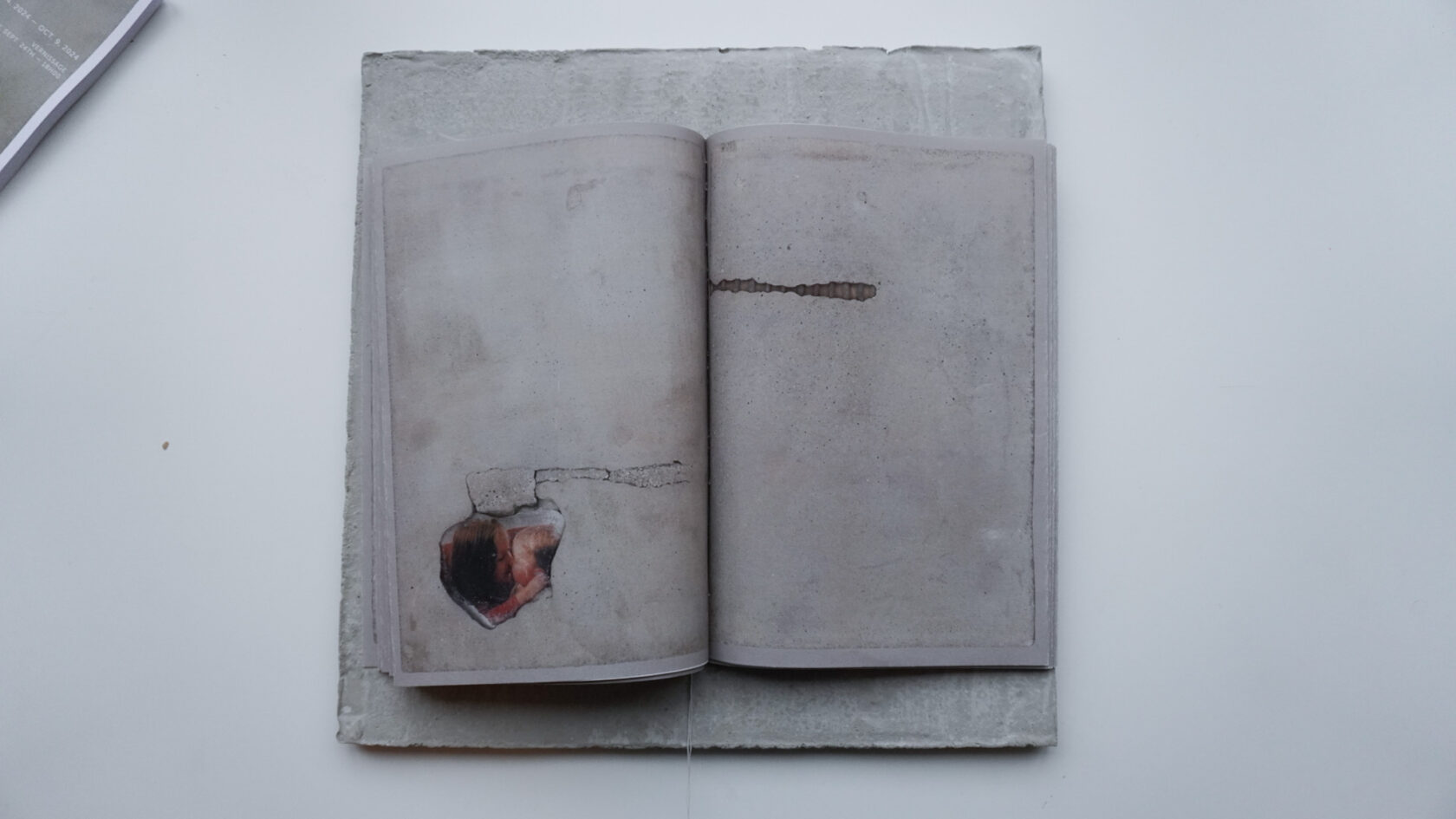
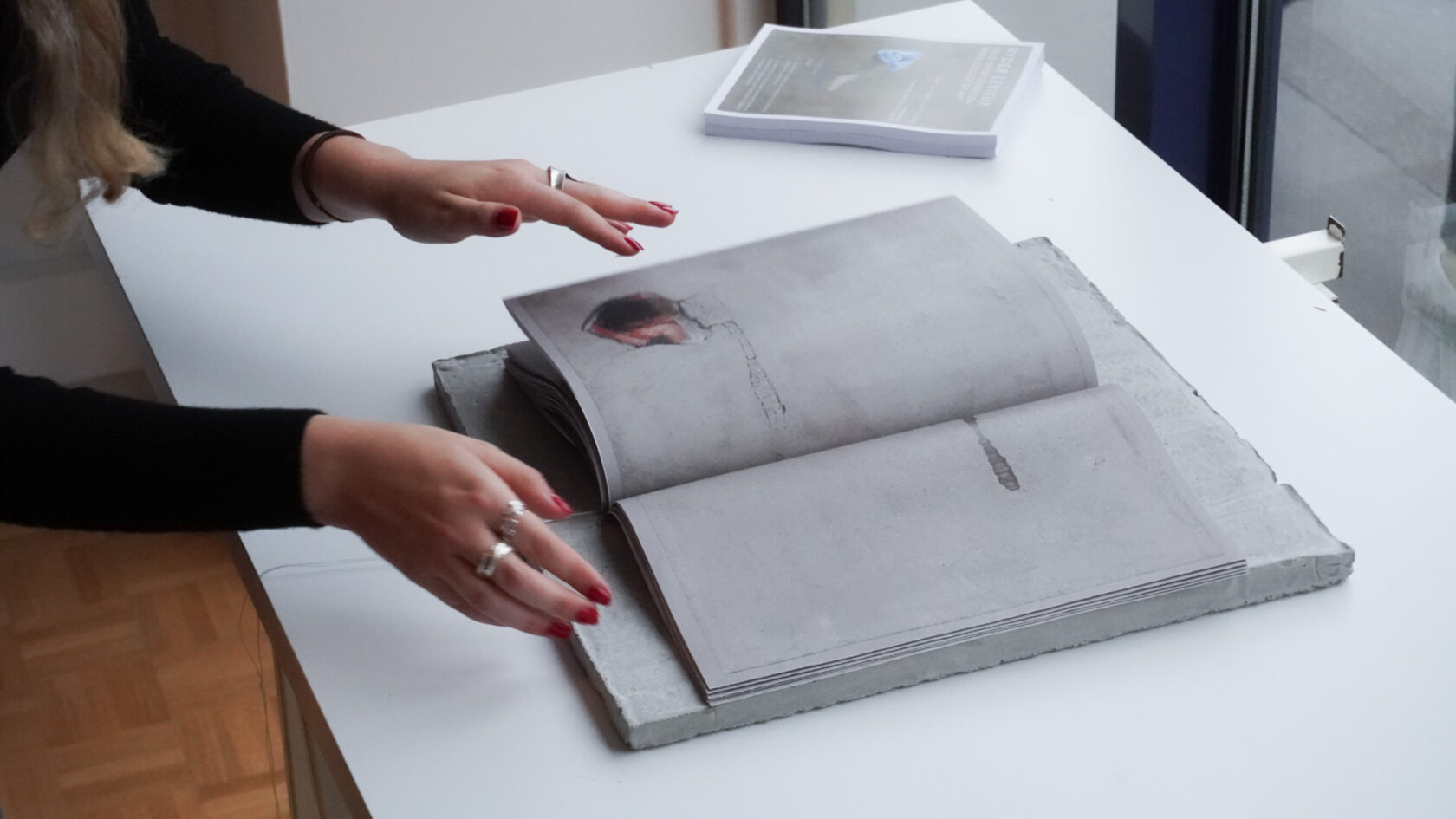
The “Savoir-Faire” assignment, which was to discover our “know-how” for my fine art studio course, was key. But I also have to give credit to my graphic design course. That really opened my eyes. I had already kind of done books in the first semester… I had done a project with stains, and I made a book of stains where you had to physically touch them. I was really into that. So then when I took the graphic design course, I knew I wanted to make a book, but my teacher suggested, “What if you scanned the concrete?” And I was like: yes! So I scanned the concrete, and that’s how I made the book that was in the exhibit. I scanned the concrete and kind of made it into this publication.
Can you talk about the inspiration behind “Aggregate” and how memory and materiality play into your work?
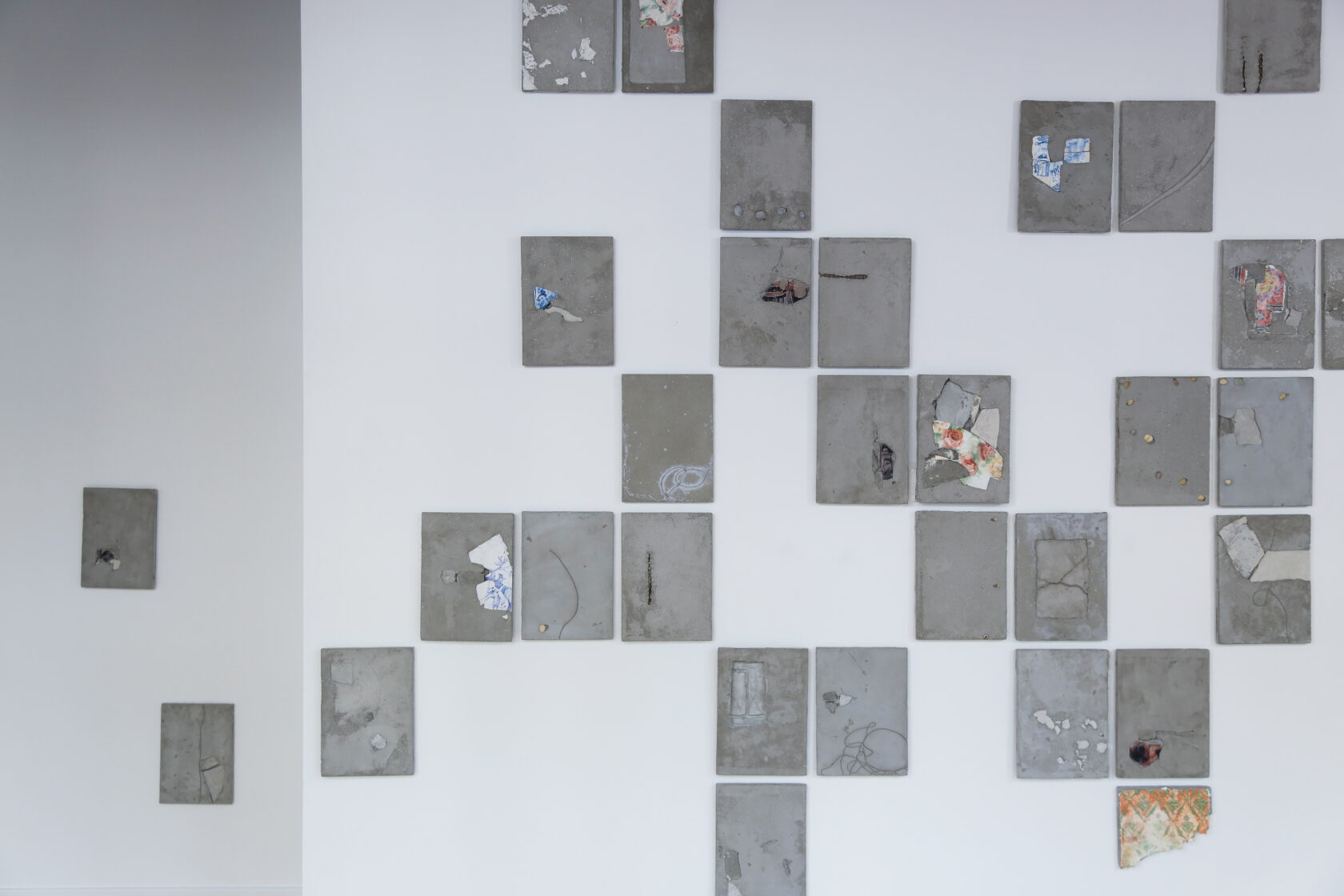
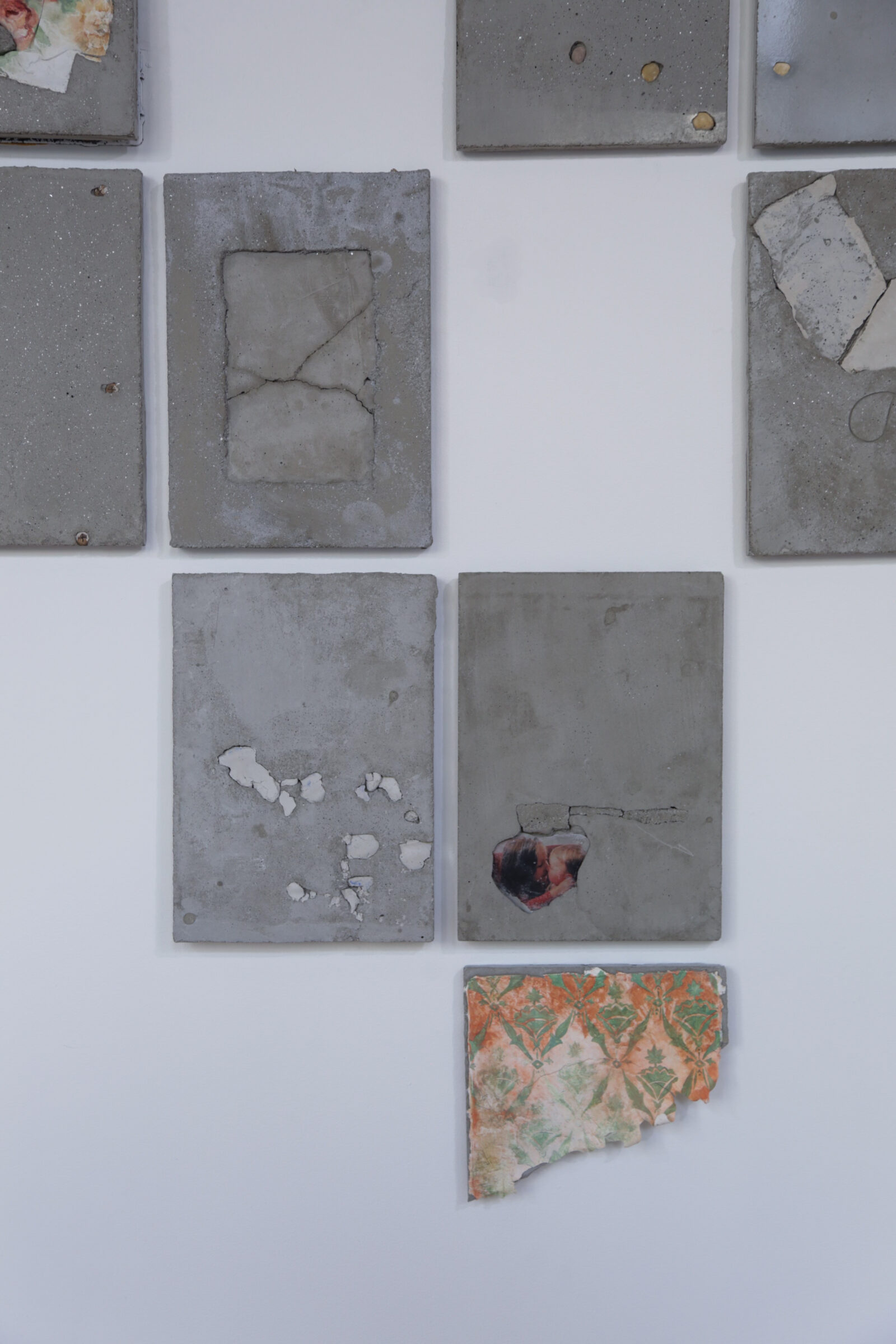
Aggregate as a whole encompasses my personal memory, but also the memories that can be left on the spaces we inhabit. My personal memories are more in the floor plans and in the specific photo transfers on the concrete. I intentionally used only archived family photos of me when I was young. I’m not very recognizable as me—kind of, but not really—and I didn’t want to have too many recognizable features because I wanted it to be anyone’s photos, while also having a connection to me. A lot of artists like to use found objects, but I actually feel uncomfortable using them because, for me, the history those objects have gone through is so important. That’s why in Re-collections, which is the concrete work, I made every single element of it. The rebar is made of ceramic, the rocks are made of ceramic. Everything is a replica. And because a lot of the elements are broken and reincorporated, hence the title Re-collections, they have a history of being broken. They were something else before they became this, and before they were incorporated into the concrete.
How do you select the materials for your pieces, and what role does emotion play in these choices?
Concrete is a very interesting material because I knew I wanted to use a kind of architectural material, something common in architecture. But concrete is also a material I could mold in a way. I’m a really big perfectionist, so I need the material to create the imperfections for me because I don’t like the aesthetic of imperfections, even though I’m drawn to them. I like to draw in ink, and I use concrete because I can’t control the outcome. Ceramics, on the other hand, were just a way to make something interesting.
What challenges did you face during the creation of “Aggregate,” and how did you overcome them?
I think the challenges were that I didn’t know anything about concrete, and I had to accept the fact that things were going to break. Once I accepted that, it became easier. But when I had a piece I loved and it broke… oh, that hurt. And when I was setting up at the Bastille Design Center right before my critique, one that was broken at the bottom fell off the wall. It was the only one I had used as a piece to cover the entire thing in a mosaic, and it took five hours to make. It turned out to be more of a focal point of the piece. But having to accept that things you spend a lot of time on are going to break and become smaller pieces in your final work was tough.
How did PCA’s environment influence your creative process and collaborations?
I’d say my friends influenced me the most! Honestly, talking with the friends I’ve made here… we’re creative people who go to the bar, have these discussions, and come up with really beautiful things in the end. That’s one of the most important things I’ve gotten from the school—friendships that are real creative partnerships. And they’re beautiful, not just in terms of relationships but also in the amazing creations that come from them.
What role did critiques and faculty guidance play in the evolution of this exhibition?
My critique went well. I did my thesis at the beginning of the year, and it was completely different from what this became. The guidance of my teachers was very helpful. When is it not? When I was making this, they showed me references and supported me—that’s the main thing. The critiques themselves were very helpful, but more so because I learned how to talk about my work. I also think it was helpful to brainstorm titles, because I hate doing titles. Naming this exhibition was so difficult. But working with one of my teachers, we played a lot with words. So, I came up with “collection” and then “recollection,” and how we can make these kinds of re-collections.
You recently received the Jury Honors Award—how has this recognition affected your career and future projects?
I feel more comfortable calling myself an artist now that I have a solo exhibition under my belt and have received the award. I think it’s a great jumping-off point—”Hey, I won this at my school!” And especially if I want to apply to master’s programs, it’s definitely going to look good in my portfolio.
Looking forward, how do you see your work evolving, particularly in terms of integrating memory, emotion, and materiality?
I think I’ve found my niche, and I’m going to springboard off that. I love doing this—it’s so much fun. I came from a realism painting background, so spacing out and painting flowers for two hours is fun for me. I like to collect textures I see, like cool fabrics and rugs, and then incorporate them into my painting. Besides that, maybe I’ll apply for a master’s degree? Definitely applying for more exhibitions.
Follow Ryder’s work here.