Pixel Shifting: An Online Exploration of Digital Art
A Retrospective on Process, Participation, and Poetics
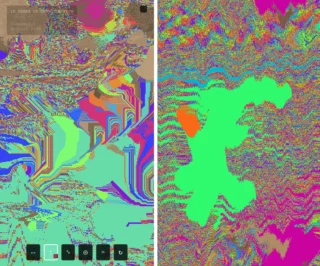
As part of the 10th anniversary of the MA/MFA in Transdisciplinary New Media department (MTNM) at Paris College of Art launched Pixel Shifting: An Online Exploration of Digital Art—a global, collaborative experiment that brought together artists, alumni, and digital explorers from across the world. Conceived by Jacob Karr, a second‑year MTNM student, Pixel Shifting reimagined the generative pixel works of German artist Kim Asendorf, transforming the concept into a human‑driven, real‑time digital performance. Over five days, participants collectively shaped a living, evolving canvas—pixel by pixel, gesture by gesture—using nothing more than their mouse pointer.
Pixel Shifting: Origins, Process, and Reflections
The conceptual foundations of Pixel Shifting emerged from a blend of social experimentation and digital aesthetics. Long before the project took shape, Jacob Karr had been captivated by large‑scale participatory canvases such as Reddit’s r/place, where “millions of users following these simple rules gave rise to emergent and intentional images”. This fascination with collective mark‑making later intersected with the glitch‑based pixel algorithms of German artist Kim Asendorf. Karr was drawn to the way Asendorf’s works “push, pull, and shift an image into a new one,” and he sought to reinterpret these algorithmic gestures as creative tools—“tools, brushes really, that participants could use to change the work over time”.
Rather than positioning viewers as passive observers, the project invited them to become active participants, breaking down the boundary between audience and artwork. This approach felt particularly resonant within the context of MTNM’s tenth anniversary, where experimentation and collaboration have long defined the program’s ethos
Sketches, Prototypes, and Early Explorations
The development of Pixel Shifting was shaped by a series of conceptual sketches and prototypes. Some ideas remained on paper, including a rhizome‑inspired network in which participants acted as nodes—“connecting and disconnecting, coming and going, but together forming a net that represents the program”.
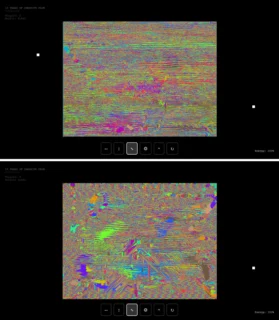
Another concept, Aglet, reached a functional prototype. Inspired by the artist’s own entanglement with Europe, MTNM, and its community, the piece envisioned participants guiding a shoelace tip under, over, and between, forming knots that are difficult to untie”. These early experiments informed the project’s final direction, reinforcing themes of connection, tension, and shared
authorship.
Technical Architecture and Design Logic
Technically, the work was built within an HTML canvas, framed by a minimal interface of text, buttons, and a central viewport. HTML provided the structural hierarchy, while JavaScript handled the pixel‑level logic—tracking “each pixel, its neighbors, and so on”. A lightweight Node.js WebSocket server enabled real‑time interaction among participants, allowing many users to manipulate the same digital surface simultaneously. The piece was hosted for the duration of the event, functioning as a living, evolving system shaped by the unpredictable rhythms of collective engagement.
Participation, Emergent Behavior, and the Artist’s Perspective
Jacob Karr imagined participants arriving with no instructions, learning through experimentation and play. Each gesture layered over the remnants of another’s actions, creating a dynamic palimpsest of intentions, accidents, and interventions. He hoped for the emergence of a “metagame,” or even attempts to break the system entirely. One such moment occurred when a student discovered that the radial shift tool could erase the entire canvas in blue—an unexpected behavior Karr affectionately described as “our own little Malevich.” This spirit of discovery and disruption became central to the work’s unfolding.
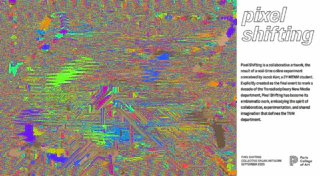
For Karr, the final artwork held personal significance. It reflected a generational tension—“too young to have experienced the golden era of Net Art”—and the challenge of using contemporary web tools, now often associated with commercial platforms, for poetic ends.
The project did not resolve this tension, but it affirmed his commitment to exploring the expressive potential of digital systems. The work also embodied the ethos of the MTNM program, which brings together “technologists, game designers, musicians, performers, writers, visual artists, and object makers” in a shared space of experimentation and interdisciplinary exchange.
Looking Forward
In reflecting on the project’s impact on his artistic practice, Karr acknowledged the unique conditions of new media work. Unlike traditional art objects, digital pieces often emerge in response to calls, grants, or collaborative frameworks. Yet this constraint became a source of strength: “Continuing to respond to such calls, like strengthening a muscle, will serve me well”.
Pixel Shifting thus stood not only as a celebration of MTNM’s decade of creative flow, but also as a marker of the artist’s evolving trajectory—an exploration of how collective digital gestures can form a living, shifting portrait of a community in motion. To honor the collective spirit that shaped Pixel Shifting, the final evolving artwork was prepared to be transformed into an artwork to be shared—small, luminous fragments of a much larger shared gesture. Pixel Shifting offered participants and supporters a tangible keepsake of the moment when hundreds of hands, cursors, and intentions converged into a single shifting canvas.
*Related to this article is the event PIXEL SHIFTING: https://www.paris.edu/pixel-shifting-anonline-exploration-of-digital-art/